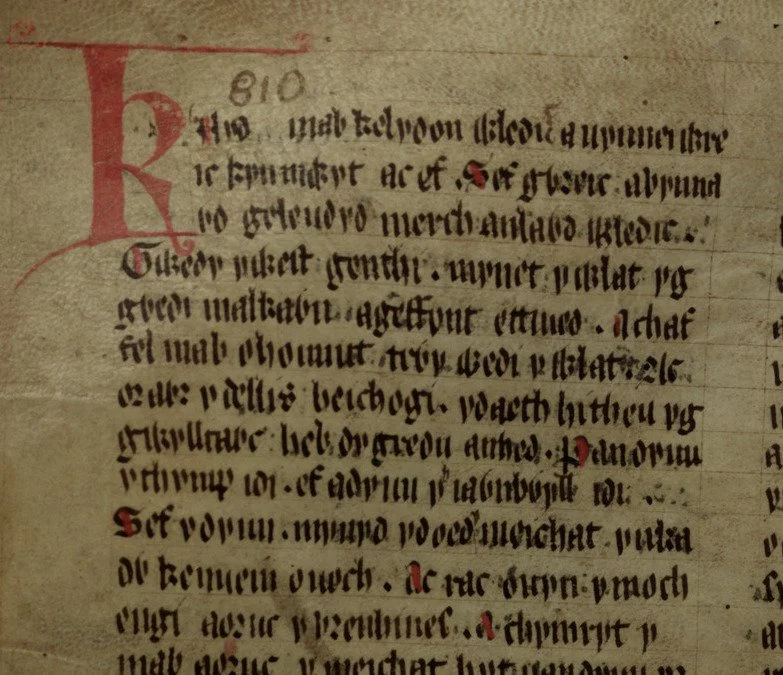
Reading the story.
The default approach to medieval texts is to see them as clumsy approximations of modern literature. Applying the learnt critical manoeuvres of modern literary studies can lead not only to frustration but to the assumption that these stories are flawed.
When Culhwch asks him, Arthur says he’s never heard of Ysbaddaden. Later, Ysbadadden tells Culhwch Arthur is ‘in my hand’. In a modern story we might be tempted to assume one of them must be lying and tease out the implications. Culhwch is Arthur’s maternal cousin. But Arthur’s other aunt is married to Custenhin the shepherd, who in one version of the story is Ysbadadden’s brother. Surely Arthur would know who his aunt is married to? Why is Arthur lying? Perhaps he’s embarrassed by his subservience. Ysbadadden can’t be killed unless Olwen is married. Culhwch’s quest offers Arthur the opportunity to escape the giant’s power. This explains why he and his men are so willing to complete the tasks at such great loss of life.
This kind of ‘school room analysis’, is very enjoyable,. It gives Arthur ‘a motive’ easily understandable to a modern audience. It would make a decent premise for a rewriting of the story. .But it’s also out of place. It assumes a story must have internal consistency, when it’s obvious this story works well without it. If Arthur is plotting to kill Ysbaddaden, why do his messengers take a year and a day to fail to find him? If Arthur is in his power, why doesn’t the giant order him to stay out of the quest? There are numerous examples of inconsistency. .
Why does Arthur insult Kei? More to the point, how is what he says so insulting that Kei refuses to have anything more to do with him?
When Culhwch’s stepmother meets the old woman, she asks where are her new husband’s children? The old woman replies:
‘He has no children.’
‘Woe is me’ replied the queen,
‘bound to a sterile man.’
‘No need for tears.
There’s a prophecy
he will have an heir,
and since he hasn’t already,
he’ll have it with you.
Don’t be sad, either,
he has one son.’
It’s possible that there is a play on words here, but if so it’s very strained and still doesn’t make any sense.
One of the tasks involves Arthur and his men finding Mabon mab Modron. To do this, they have been told that first they must find his cousin, Eiddoel mab Eri. They find Eiddoel after searching throughout Britan. He's a prisoner in a place called Gliui by someone with the same name.
Gliui is identified by the editors as Gloucester. Fair enough. Later, after a trek from one 'Oldest Animal' to an 'Even older animal' our heroes discover Mabon is being held prisoner in Kaer Loyw, which the editors also identify as Gloucester.
So they free Eiddoel from the same place they free Mabon, though they go round the Wrekin to do so.
How can they both be prisoners in the same place? Who is keeping Mabon prisoner? Presumably it’s not Gliui because he's offered Arthur his help and support? Was he lying? Is Arthur at fault for not asking Gliui if he knows where Mabon is? Why do they assume that 'No one knows where Mabon is' means 'Don't ask anyone except an animal'? Why does no-one else on the river hear Mabon lamenting? Why have they been told they needed Eiddoel to find Mabon when he contributes nothing to their search?
Why is the episode so satisfying and enjoyable until you start asking these questions?
Part of the skill of reading a story is knowing which questions are inappropriate. To use a more familiar example, in Snow White. why does the Prince ask if he can have the dead girl in the glass coffin? What will he to do when he gets her home? What will his parents say?
If you go looking for character development, motivation, internal consistency, you are liable to be frustrated and disappointed. It’s not just the inappropriate application of a reading practice that is designed to scrutinise a printed text that was written in the expectation of that kind of scrutiny. It’s also an assumption that modern literary reading practices are the only ones in town. It leads to a default approach to medieval texts that sees them as clumsy approximations of modern literature.
This is highly patronising to the creators of our texts: if only they'd have been to a modern writing workshop they might have done better, and insulting to their audience who were obviously willing to put up with any kind of rubbish because evenings were long and Netflix hadn't been invented.
I like these stories the way they are. I suspect the original audience did as well.
Quisque iaculis facilisis lacinia. Mauris euismod pellentesque tellus sit amet mollis.