For the first time on the Poetry Voice we have a guest reader.
Lauren Frederick reads two poems from her new collection, i saved a seat for you.
You can find more about her book by clicking on the link..
Ivor Winters' 'Sir Gawain and the Green Knight'
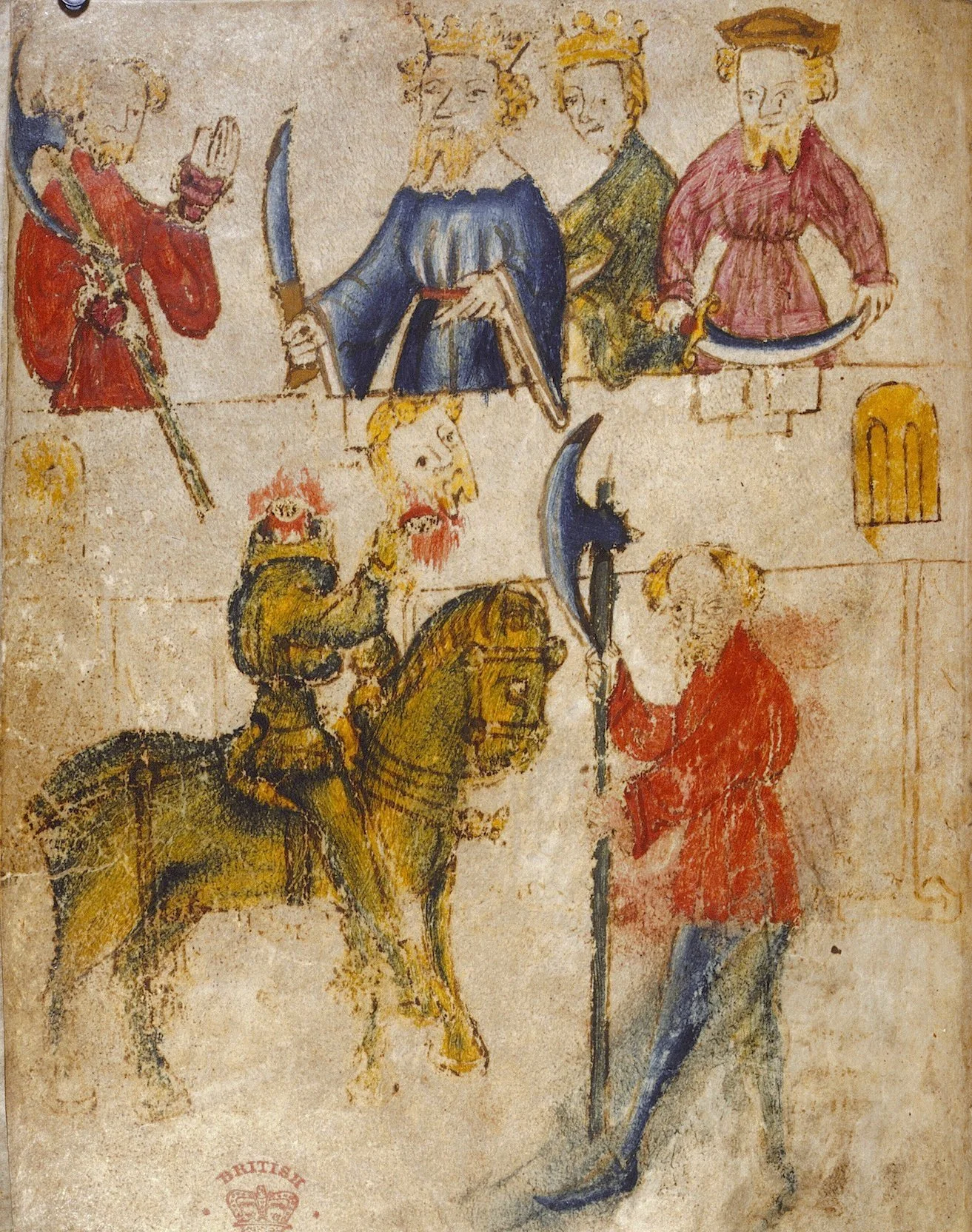
Manuscript illustration of Gawain and the Green Knight.
Yvor Winters (1900-1968)
Neither Sir Gawain, nor the Green Knight, are as well-known as Hamlet or Goliath (see previous posts). So Winter’s poem raises the question; if you don’t know the story it’s based on how effective is the poem? It becomes a stark example of the problems of literary allusion and ‘meaning’.
Winter’s poem contrasts the dangerous green, living natural world against the dead dry world of men and their self-made codes, which are like roads leading through the wilderness.
Does Gawain make the right choice?
If you don’t know the story, I’ll summarise it after the audio file.
This poem taken from ‘Yvor Winters, Selected poems, edited by Thom Gunn for the American Poets Project.
If you don’t know the story, read on.
‘Sir Gawain and the Green Knight’ is a fourteenth century poem that survives in a single manuscript. The story begins in King Arthur’s court at Christmas when a huge green knight on a huge green horse rides into the court and challenges everyone to a game. He will stand one blow of his own axe as long as he can return the blow in a years’ time.
No one at the court wants to take him on, but as Arthur finally gets up the young Gawain gets in first. He effortlessly decapitates the Green Knight who then gets up, picks up his head, remounts his horse and says ‘see you in a years’ time’.
The rest of the story tells how Gawain is tested and discovers the limits of his idealism. He bravely sets out to keep his word, is undaunted by the physical hardships of a terrible journey, and finally arrives at a castle where his host tells him the place he seeks is just a few hours away, so why doesn’t he stay for three days. The host then proposes a game. He will go hunting each day and give Gawain whatever he kills, and Gawain will give him whatever he gains during the day.
For the first two days the host’s wife visits Gawain in his bedroom. His morality tested, Gawain gently rejects her advances, and she gives him a kiss. Each day the host returns, gives Gawain what he hunted, and Gawain gives him the kiss. On the third day the Lady gives him a Green Girdle which she says will protect him against the Green Knight. Gawain does not give this to the host.
He rides out to the Green Knight’s ‘chapel’. Twice the Green Knight goes to strike and twice Gawain flinches. The third time he strikes, but only nicks his neck.
When Gawain returns to Arthur’s court he is mortified. He failed the final test and tried to cheat. He wears the green girdle as a badge of his shame. But everyone in the court thinks this is daft, and starts to wear green girdles as well.
The story opens the debate. Gawain is true to his code, but as a human being he has tried to avoid death. Should he feel ashamed? Or are the people in the court right?
Wilfrid Owen's 'The Parable of the Old man and the Young'
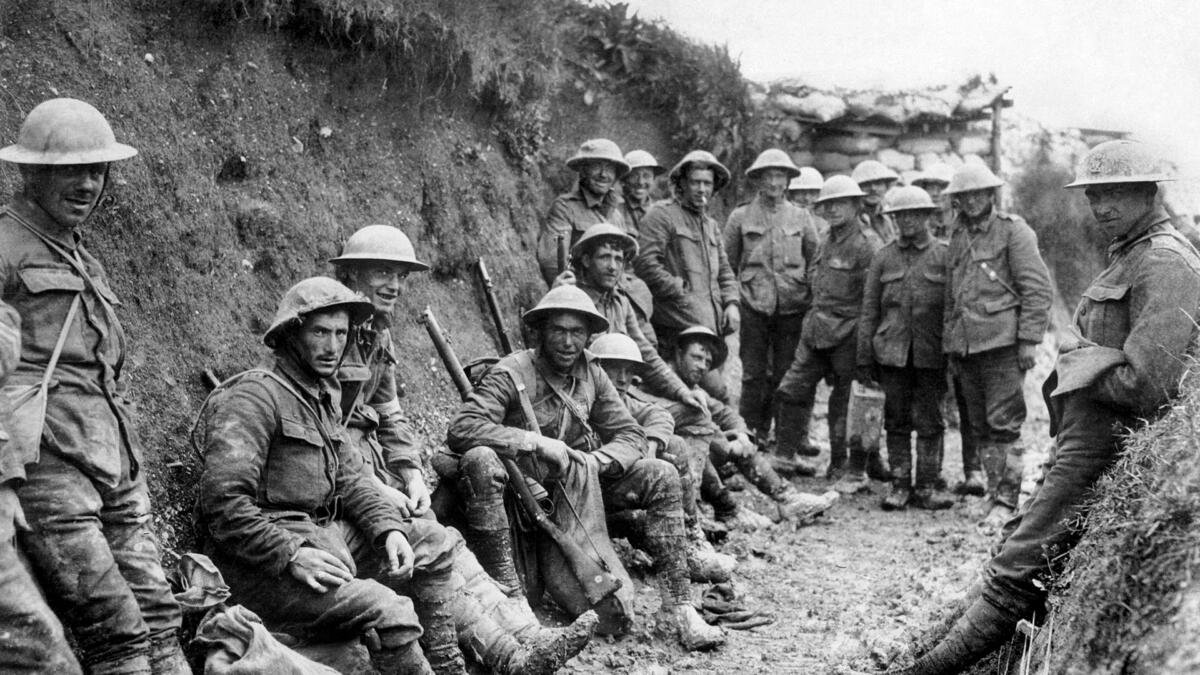
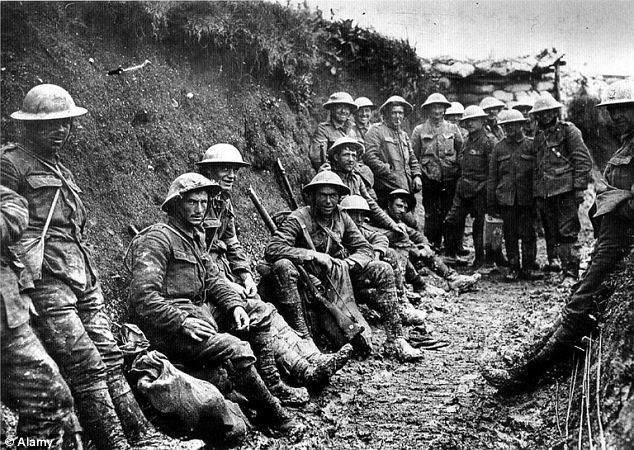
Men of the Royal Irish Rifles in the opening hours of the battle of the Somme 1916
Wilfrid Owen (1893-1918)
The last of a short run of poems in which poets use familiar names and stories in their poems.
In the Book of Genesis ,Abraham is tempted by God, who tells him to sacrifice his only son. Obediently Abraham takes Isaac, and is prepared to kill him, but God interrupts and offers him an animal to sacrifice instead.
One wonders about the conversation between father and son on the way home.
Owen’s poem revises the well-known story. The old man refuses to sacrifice the Ram of Pride God offers him, and goes on with the slaughter. As statement the poem’s effective, as a poem it’s heavy handed.
The archaic diction and syntax evokes the memory of the prose of the King James Bible; but the ‘belts and straps’ and ‘parapets and trenches’ seem an unnecessary attempt to force the link between Biblical sacrifice and the trenches and parapets of the first world war, manned by young men wearing belts and straps. I’ve always felt that he didn’t trust his readers to make that link
At the risk of being heretical, Leonard Cohen’s lyric to the song ‘The story of Isaac’ makes the same point more powerfully, and more effectively.
John Dressel's 'Lets Hear It For Goliath'
John Dressel (b1934)
I worry about my pronunciation of people’s names, so if I have mispronounced John Dressel’s I apologise.
Like Hamlet (see previous episode) Goliath has escaped his story.
Recently a news headline read; ‘Firm wins in David and Goliath legal battle’.
The writer of the headline was confident that the reader would know that this meant a battle between a small firm and a much bigger one. The writer was also positioning the reader to see the smaller as heroic and admirable, and the bigger as the bad guy in the case.
The story of David and Goliath has entered into popular discourse, and people who have never read the Bible know enough to make sense of that headline.
But there’s no reason why we should automatically sympathise with David, or with every small entity taking on a larger one. Dressel’s poem makes this point, playfully.
This poem is taken from ‘Twentieth Century Anglo-Welsh Poetry’ edited by Dannie Abse and printed by Seren/Poetry Wales Press 1997, reprinted 1998.
Gwyn Thomas’ 'You've Lived'.

Young man with a skull. Painting by Frans Hals.
Gwyn Thomas (1936-2016)
This is the first of a run of poems in which poets use other works of literature or characters from literature to make a point or to consider an idea. Hamlet is one of the most famous characters in the western tradition, so much so that he has escaped his play and lives a life of his own. People who have never seen a version of the play or read it have heard of him. ‘To be or not to be’ entered everyday speech so long ago it may be used without any knowledge of what the rest of the speech contains.
It’s a young man struggling to verbalise a reason for either living or dying.
Anyone can be driven to ask ‘what is the point’ or ‘what is the meaning of life’. You don’t need to be haunted by what may be the revengeful ghost of your father, or suspect your mother of adultery with your regicidal, fratricidal uncle. Once the religious and philosophical answers have been rejected, the purpose of life becomes finding a a purpose that will make life seem desirable. As Thomas says in this poem, it doesn’t have to be a desire to win an olympic medal or climb mount Everest. Growing onions will do it. Only when you have a reason to live, that matters to you, will you fear death, and only having feared death will you have lived.
I found this poem quoted at the end of Tony Conran’s introduction to ‘Welsh Verse; Translations by Tony Conran.’ Poetry Wales Press 1986. I knew of Gwyn Thomas as a translator of The Mabinogion and his reputation as a poet. I know very little about this poem except I assume it’s translated by Tony Conran from Welsh. If anyone knows differently please let me know.
W.B.Yeats' 'Politics'

Sunset on a pacific Pacific. Photograph Copyright Liam Guilar.
W.B. Yeats (1865-1939)
I have been rereading Yeats. Something I recommend everyone with an interest in English poetry should do. It’s difficult to think of a collected poems which has so many great poems in it, or where the quality improves chronologically.
This poem sits at the end of his ‘Last Poems’. It’s not a great poem by his standards, but the honesty of it is appealing. Old men are just young men in failing bodies and Yeats was acutely aware of this. The last two lines express an impossible wish but also acknowledge and accept what has passed.
If you wanted to, you could ask yourself which is the more human response: the men obsessed with politics, or the man admiring the girl. You could also ask yourself which one of the two is less likely to start a war.
Roy Fisher's Birmingham Screwdriver.

A Birmingham Screwdriver in action.
Roy Fisher (1930-2017)
Roy Fisher is one of those poets who are highly regarded by critics and readers who know his work, and yet nowhere near as well known as he should be.
This poem is an extract from Talking to Cameras, the first part of the sequence ‘Texts for a Film’. I laughed the first time I read it. As he explains, a Birmingham screwdriver is a hammer, I grew up in Coventry, about 20 miles from Birmingham, and I often heard the phrase. It’s one of those faintly humorous regional insults that abound in the UK, suggesting something about the craftsmanship and craftsmen from Birmingham.
But Fisher takes what is an insult and turns it into a mediation on a way of thinking. It’s the shift, and the humour, that distinguishes this poem.
The poem is taken from ‘The Long and Short of it, poems 1955-2010 (new edition 2012) Bloodaxwe books.
W.B.Yeats' 'The Fisherman'
W.B.Yeats (1865-1939)
Who are you writing for? For anyone writing poetry the question seems essential.
At some point in his career Yeats had wanted to be a national poet, writing for and on behalf of his country. But in this poem he renounces that ambition, having, he says, discovered that the people he thought we was writing for and about are not worthy. He renounces them for an imaginary figure, a solitary fisherman. And in the poem’s most memorable image, Yeats hopes that before he’s old, he will have written him one poem ‘as cold/and passionate as the dawn’.
You can spend some time admiring those two adjectives, and the effect they create.
Hugh Kenner suggested the difference between Yeats and Pound, or Yeats and most poets, was that Pound, once he’d left London, could sit in relative isolation at his typewriter in Rapallo telling himself he was a genius and dismissing any rumours of negative response to his work as the sniping of lesser interigences. Yeats, standing in the wings at the abbey theatre was forced to confront an often baffled, sometimes hostile audience. It might be one of the reasons Yeats’ poems got better as he got older.
Two Epitaphs for an Army of Mercenaries
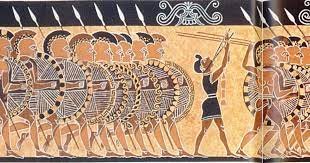
Xenophon and the March of the Ten Thousand to the sea.
The second of these two poems was written in direct response to the first.
A.E.Houseman (1859-1936) was one of the leading classical scholars of his day. Today he’s remembered as the author of ‘The Shropshire Lad’, one of the most well known collections of poems from the first quarter of the last century. I suspect his mercenary army owes a lot to Xenophon’s classic account of how ten thousand Greek soldiers marched to the sea after their Persian paymaster was killed in battle.
Hugh MacDairmid (1892-1978), one of the significant Scottish poets of the twentieth century, had a less romantic view of Mercenaries. which i suspect might be shared by those unlucky enough to have encountered them.
from 'Watt' by Samuel Beckett
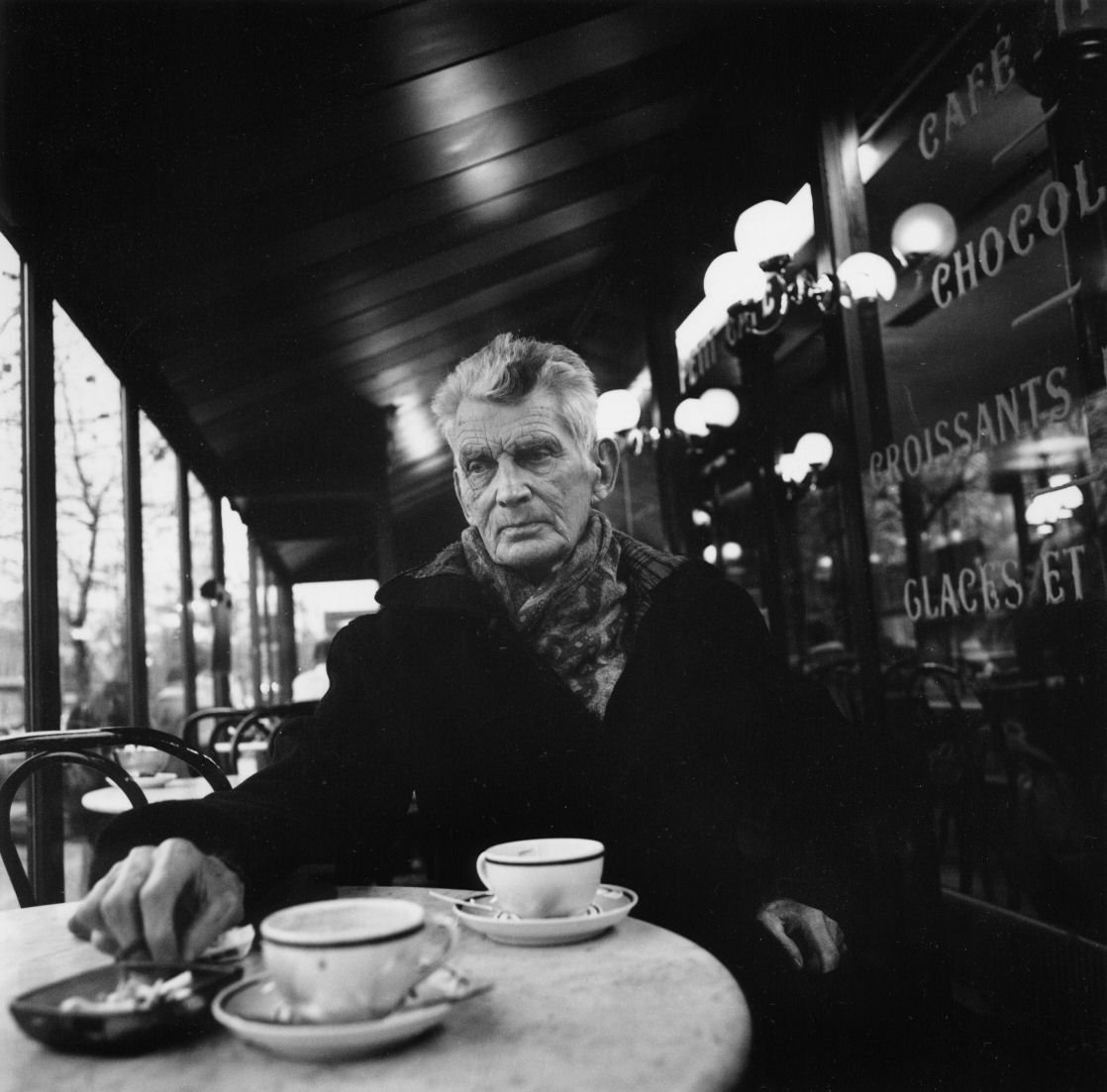
Samuel Beckett in a Paris Cafe.
Samuel Beckett (1906-1989)
Technically this isn’t a poem, but an extract from Beckett’s novel Watt, where it’s set out as continuous prose. But it’s too much fun to read to leave out on the grounds that it’s not ‘a poem’.
If you want to tie your head in knots you can try to define ‘poetry’ and ‘poem’. Whatever your definition there will always be a liminal case that challenges the definition. Beckett’s prose is also often a lot funnier than the stern photos of Beckett would lead you to expect. So go along for the ride. And enjoy.
Rudyard Kipling's 'The Last of the Light Brigade'
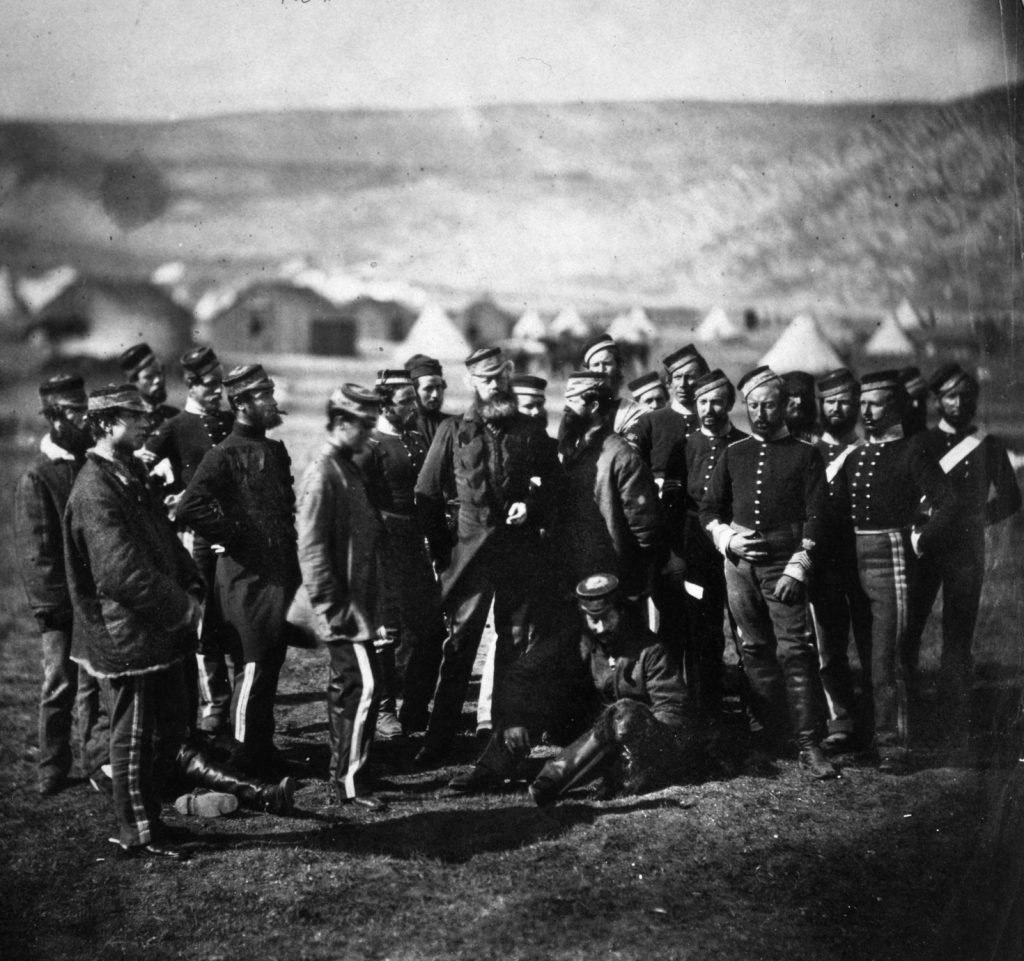
Officers and men of the 13th Light Dragoons who survived the Light Brigade’s charge.
Rudyard Kipling: 1865-1936
This isn’t one of Kipling’s best poems. But it reveals a side of him most people ignore. The incident described here is probably apocryphal. The savagery of the last line depends on a play on the meanings of the word charge. It’s too vicious and carries too much contempt to call it a pun.
The Charge of the Light Brigade occurred during the Battle of Balaclava in 1854. In what is sometimes remembered as one of history’s great military blunders, or stupidities, approximately 670 British lightly armed cavalry charged straight down a valley at Russian Cannons with Russian batteries firing at them from either side. There is no record of any of the troopers saying, this is a really stupid idea…Surprisingly, there were some survivors. It would probably have been quietly forgotten to every one but military historians of disaster, a classic case of bad communication, if Alfred Lord Tennyson hadn’t written ‘The Charge of the Light Brigade’ within weeks of the event.
The popularity of the poem, taught in British schools for the best part of a century, can be measured by the way phrases from it entered into popular discourse. ‘Someone had blundered’ ‘there’s not to reason why/there’s but to do and die’ even if the quotations were often incorrect.
As part of the education of British children, the poem with its insistence on the courage, glory and honour of the participants, contributed not just to to the mentality that lead to equally disastrous military stupidities in the First World War, but the the enthusiasm for the military that contributed to so many eagerly signing up for that war.
Kipling’s poem, written almost forty years after Tennyson’s is an indirect critique both of Tennyson’s poem and the British Public’s attitude towards its military, which he criticises in other poems, most simply in ‘Tommy’.
Memory, from A Man of Heart.
This is taken from A Man of Heart, by Liam Guilar. Published by Shearsman books 2023.

Lullingston Roman Villa remains, Kent, England.
Maxim 1
History is a record of brutality
tempered by outbursts of idealism.
Memory
There was never enough light
Even in summer, shade
and shadows contour brightness.
At night, torches and lamps
shiver the edge of sight.
The candle drew attention to itself
while life continued in the silent,
darker ebb and pool beyond.
I remember her hand on the pillar,
a shadow on the white stone.
Her eyes bright in a dark face.
She was worried, there were visitors,
men of power and influence,
come to court her daughter.
Not bad for a freed slave
from the lands around Carthage.
I remember her hand on the pillar,
the light shaking over the mosaic floor.
She had plans. We all had plans.
The Wassail ceremony. Vortigern meets Rowena
This extract is taken from A Man of Heart, by Liam Guilar. Published by Shearsman books (January 2023)

Rowena offers Vortigern the Cup.
If you’ve ever ‘Gone Wassailing’ or heard the Christmas Carol ‘Here we come a wassailing’ and wondered what wassailing was, it comes from this story.
The Old English greeting Wes Þu hal (Be well!) became Wassail.
In the previous episode of The Poetry Voice I read an extract from A Man of Heart in which Hengist left for Britain, leaving his daughter on the shoreline, watching him depart. One he established himself he sent for her, and in this extract he’s pitching her at Vortigern the King. If the king marries his daughter, Hengist will become the grandfather of Kings. In my version of the story, Vortigern is aware of Hengist’s plan, thinks he’s in control, but then he meets Rowena for the first time,
If you’d like to see the original Middle English version of this episode, I’ve pasted it below.
Reowen sæt a cneowe; & cleopede to þan kinge.
& þus ærest sæide; in Ænglene londe.
Lauerd king wæs hæil; For þine kime ich æm uæin.
Þe king þis ihærde; & nuste what heo seide.
þe king Vortigerne; fræinede his cnihtes sone.
what weoren þat speche; þe þat maide spilede.
Þa andswarede Keredic; a cniht swiðe sellic.
he wes þe bezste latimer; þat ær com her.
Lust me nu lauerd king; & ich þe wulle cuðen.
whæt seið Rouwenne; fæirest wimmonnen.
Hit beoð tiðende; inne Sæxe-londe.
whær-swa æi duȝeðe gladieð of drenche;
þat freond sæiðe to freonde; mid fæire loten hende.
Leofue freond wæs hail; Þe oðer sæið Drinc hail.
Þe ilke þat halt þene nap; he hine drinkeð up.
o[ð]er uuel me þider fareð; & bi-thecheð his iueren
þenne þat uul beoð icumen; þenne cusseoð heo þreoien.
Þis beoð sele laȝen; inne Saxe-londe.
& inne Alemaine; heo beoð ihalden aðele.
Hengist Leaves for Britain. From Liam Guilar's 'A Man of Heart'.
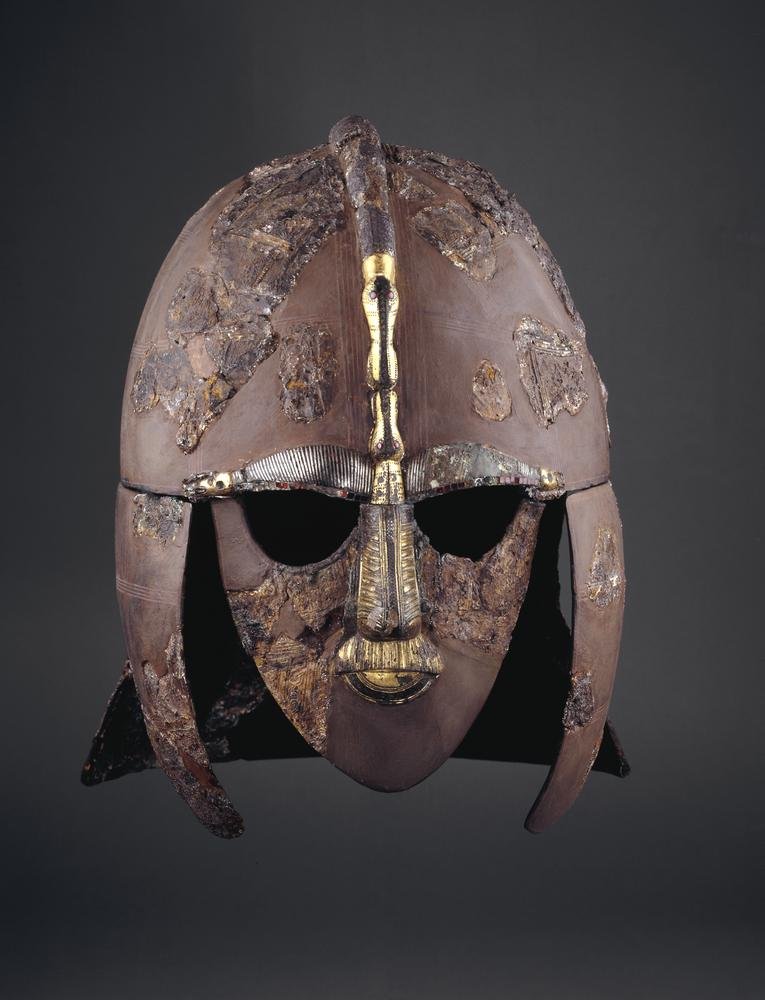
This extract is taken from ‘A Man of Heart’ by Liam Guilar, published by Shearsman in January 2023.
The Venerable Bede dated this event to 450 AD. The British, attacked on all sides, abandoned by Rome, hired mercenaries to help them to fight their enemies. Traditionally, they hired three boat loads of ‘Germanic Warriors’, led by Hengist and his brother, Horsa. On the beach watching them depart is his daughter, Rowena, who will play a significant role in subsequent events.
Their story is told in A Man of Heart.
Michael Alexander's 'Beowulf Reduced'

Michael Alexander’s translations of Old English poetry, published by Penguin Classics, were my introduction to the literature of Anglo-Saxon England. His translation of Beowulf, carefully preserving the alliterative sound of the poem, was a ‘best seller’ in the world of translations.
‘Beowulf Reduced’ is his tongue in cheek synopsis of the story, cutting three thousand lines down to fifteen. It was published in Alexander’s Here At The Door by Shoestring Press in 2021.
Robert Browning's 'Childe Roland to the Dark Tower Came'

Robert Browning (1812-1889)
There’s a story. A bemused reader asked Browning what this poem meant. ‘Well,’ said the poet, ‘when I wrote it only God and Robert Browning knew. Now only God knows.’
Sadly this conversation didn’t take place, and the comment was most likely made by a character called Robert Browning in a play. But it’s worth keeping in mind. There’s nothing wrong with worrying about ‘what it means’ but a better question with this poem is what does it do to you while you hear it or read it. What do the images suggest, the words evoke? Go along for the ride and experience the story before you start worrying about what it means.
The irrational came into English Literature at the end of the 18th Century with the first wave of Gothic literature. It was given substance in English poetry by Coleridge, and you can trace it through the 19th century. Browning’s Childe Roland and Christina Rossetti’s Goblin Market are two of the finest examples.
Stephen’s King ‘Dark Tower’ series ostensibly begins as a riff on this poem. But if you want a version, then Louise MacNeice’s play ‘The Dark Tower’ does a better job of capturing the spirit of the original.
William Shakespeare's 'Tomorrow and Tomorrow'

‘Out out brief candle’
Macbeth Act five, scene five, lines 18-28
Why Shakespeare? It’s a question generations of students have asked. One of the good answers is that the plays contain passages like this where you can enjoy the way a few words can be made to do a great deal of work.
Words associated with time, mortality, the stage, images of transience and futility, all coalesce in that last magnificent sentence to present one of the most nihilistic views of life in English.
Life is brief, death is dusty. There is no afterlife, no possible redemption. If there is a God overseeing it all, he she or it is an idiot. You live your life as an actor in a play, unable to make your own decisions, a puppet of the script and the director. But you’re not even a good actor, you’re clumsy, you have a bit part and if life were a film when the credits roll you can only appear as ‘man walking dog across street’, or ‘girl third from right in crowd’. You don’t even have the consolation that you took part in a masterpiece,. You’re trapped in a trivial story, written by an idiot, and it means nothing.
It's not only nihilistic, it’s also startlingly unchristian,
And then you should remember that this is a speech by a specific character at a specific moment in the play. Macbeth has made bad choices from the start. He is about to be held accountable for them. What better self-defence than to claim he had no choice? The speech may be nihilistic, but the play contradicts everything he says. He’s lying to himself.
Very clever that Mr. William Shakespeare. Wrote some good lines.
Jeremy Hooker's '1st of July 2016
Jeremy Hooker. (Born 1941)
I’m assuming this poem was written to commemorate the Hundredth Anniversary of the First Day of the Somme offensive in 1916. When i was at school we learnt the statistics; 60,00 casualties, 20, 00 of them dead. In one morning, between 7.30am and “lunch time”. By the end of the battle, which got them nowhere, when the snows closed it down in November, British, Empire and allied troops had suffered over half a million casualties.
While historians might debate the significance of the battle and the actual casuality figures, (57,470 of which 19,240 died). The image of men lined up in rows and ordered to advance into machine gun fire was a dark shadow on the collective imagination, made more terrible by the fact they were fighting in a ‘war to end wars’.
Hooker shows how effective a poem can be without the poet having to resort to distorted syntax, complex rhyme schemes or obscure allusions. The tragedy is summed up …’the old men/that we knew and the young men/we did not.’ The poem also deftly suggests a difference between then and now in its play on ‘divisions.’
The poem is taken from Hooker’s excellent ‘Word and Stone’ (Sheearsman 2019).
Liam Guilar's 'Akhmatova's requiem'

I read the poem Requiem by Anna Akhmatova on a previous podcast.
Several things made this poem happen. WHile Akhmatova lived through Stalin’s times, many of the people who persecuted her are now forgotten, they are just ‘footnotes in her history’.
I used her poem as part of a unit on poetry in translation. I would tell the story of how, when it was being written, she would write the new verses on cigarette paper. She would show them silently to her friend, who would nod when she had memorised the lines, then they would burn the paper.
Classes often found this most moving part of her story.
But at the end of every lesson, there’d be at least one of the printed copies of the poem left in the classroom, often dropped on the floor. Once one of the papers had a foot print on it.
The poem first appeared in the Irish Journal , The SHOp, and was then chosen for ‘The SHOp, An Anthology of Poetry’, their ‘best of’ collection.
Rudyard Kipling's 'The Way through the Woods'.

Rudyard Kipling (1865-1936)
If it weren’t for the rhymes, this poem feels as though it could have been written by Thomas Hardy.
Kipling could be tub thumpingly obvious when he wanted to be, riding a steady rhythm that takes his poems close to sing song. Here rhythm and rhyme are used to contribute to the way that he suggests a mood and a place and a story and leaves them to settle into the reader’s imagination.
Quisque iaculis facilisis lacinia. Mauris euismod pellentesque tellus sit amet mollis.