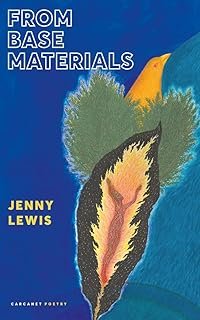
Well written poems provide the pleasure that only well-written can provide. From a re-imagining of the Rubaiyat of Omar Khayyam, via short illustrated poems reminiscent of Edward Lear, to the outrage and indignation that seethes through her poem for Sarah Everhard, the pleasure of reading Jenny Lewis’s From Base Materials lies in the excellence of its writing and the variety of its content.
Lewis’ previous book include an acclaimed version of the Epic of Gilgamesh and her translation of Adnan Al-Sayegh’s Let Me Tell you What I Saw. The latter is a book anyone interested in modern poetry, especially long form poetry, should read. The former is the most readable version of Gilgamesh you’re likely to find.
While tightly themed collections of poems all on the same subject allow reviewers to sound profound and provide publishers, if they still publicise books, with snappy publicity shorts, the reading experience can be dreary. There was a time when books had titles like ‘New poems’ and ‘36 poems’. Poets are people who live in the real world, and the real world is various and as humans their reactions to it range widely so why shouldn’t their poems?
From Base Materials moves from the private-domestic, from personal poems in which the writer describes dealing with a mastectomy and the loss of friends, the reality of ‘love in old age’, the wit of ‘Tales from Mesopotamia’ where Gilgamesh’s barber and a street dancer are grumbling, to short translations, humour, moments of reflection and outrage.
‘Hearsay’ is a sequence of three short poems (38 lines in total) about Guinivere, Arthur and Lancelot and illustrates many of the strengths of the collection,
If poems are a way of thinking through and in language, then this sequence should offer both the pleasure of itself as a well-made verbal artefact, and comment on the story of Arthur and Guinevere.
The sequence might be asking: Who is Guinevere? In answer, it suggests there are only versions: she seems unsure of, or unhappy with, her identity, while both Lancelot, and Arthur are sure they know who she is, though their versions differ.
In the first poem, ‘Guinevere’, a restless woman, shifts amongst possible identities, waiting for the miracle of recognition.
The poem begins with subversion: ‘like eve she names the birds/while waiting for miracles’. In the Christian tradition, Eve does not name anything, nor did she wait for miracles. An Eve who did these things would be rebelling against her traditionally assigned role.
However, the line refers to another poem in the collection, ‘As Adam lay sleeping’. Two pages earlier it ends:
where she, hearing clearly for the first time
the tumultuous singing of the birds,
could set about the task of naming them.
Between ‘As Adam Lay Sleeping’ [with its possible acoustic nod to the repeated line in Kipling’s ‘Four Angels’] and ‘Hearsay’ is ‘Therefore all seasons shall be sweet to thee…’ dedicated to ‘Eve, born 6 January 2020’, which ends with the poet describing her wishes for the newborn. The title, as the poem acknowledges, is a line from Coleridge’s ‘Frost at Midnight’.
The sequence ‘Hearsay’ is itself part of a sequence, gaining meaning from other poems in the book, and gaining power by drawing on the poetic tradition.
The birds Guinevere names: ‘owls, peacocks, ptarmigans, doves- ‘ provide a shifting set of possible roles which can only ‘brush against her thoughts’. The list, suggesting restlessness or uncertainty, is followed by suggestions of unhappiness.
While waiting for miracles, she is ‘polishing the round table, wanting praise.’
A literal reader might object that queens don’t polish tables. But there is a tradition of stories in which queens and princesses are punished by being forced into menial labour or into roles that are at odds with their status. In these stories the essential identity of the woman is either not recognised or not given its due. Here the queen is ‘wanting praise’. Wanting in both senses, lacking and desiring. The phrase suggests her dissatisfaction with her role, with actions that are not in keeping with her sense of her own identity, and explains why she is waiting for miracles.
She does ‘polish’ the Round Table. She brings grace to the gathering and gentles an association of expert killers. She feminises the knights. But that turns her into an adornment, something less than an individual. The fact she wants praise suggests something too about her husband’s attitude. Polishing the table in this sense is a useful activity, but the fact she keeps doing it over and over again suggests no one appreciates her efforts.
In the bath she is ‘angelic, pure, mother of pearl with light bursting from her’. Still not human. As her lover removes his armour piece by piece, ‘the naked hand that held cold steel finds/the warmth of her bird filled body’ while Arthur looks away and sees snipe and plover fall into the net.
Arthur ‘looks away’. Is he looking away as the lovers meet, or is he just watching something else. One of the questions in Malory’s version of this story is at what point does Arthur know his wife is having an affair? The second poem of the sequence, ‘Windhover’, describes the moment he realises the rumours are true.
Like many in the collection it’s a technically impressive poem, and like so many of the poems it draws on literary tradition. While windhover is a dialect name for a kestrel, it’s also the title of one of Gerard Manley Hopkins most famous sonnets. Not only has Lewis used Hopkins title and rhyme scheme, her lines end with the same words as Hopkins’, with one exception, where sillion has been replaced with stallion. The swing and swerve of the world Arthur is looking at is mirrored in the rhythm of the first eight lines.
Such technical excellence is impressive, but on its own it suggests the workshop exercise that proves little but linguistic virtuosity. The question that often goes begging is ‘to what purpose’? Here it suggests Arthur’s complicated relationship with his wife. The sense of awe that pervades Hopkins poem carries over to Arthur’s thoughts about her. But whereas Hopkin’s poem celebrates the glory of creation made specific in a single bird, who masters the elements around it. Arthur is locked into the rhyme scheme of his own misery and his vague awareness of clouds and nameless birds can’t save him from the thought of his wife and friend. Hopkins’ poem also ends;
No wonder of it: sheer plod makes plough down sillion
Shine, and blue-bleak embers, ah my dear,
Fall, gall themselves, and gash gold-vermilion.
There’s no sense of this transformation into beauty here.
He is out riding. The same clouds Guinivere saw from her bath in the previous poem, ‘like scarves stretched by the wind’ he only sees as ‘a sky full of clouds’. The poem captures the moment when he knew ‘what his heart had been hiding’….that what ‘they said about her must be true’.
Lancelot, riding on a white stallion, [Arthur’s mind slipping on the crude connotations of riding so close to white but saved by stallion instead of mare] has taken away his dear ‘his lady her raven locks her white body and her lips that burn vermillion’. Unlike Hopkins who labours to capture the singularity of a specific bird, if Arthur sees Guinevere at all he only sees surface. Lancelot has not taken away a friend, or a lover, just a ‘dear’ [with its double meaning of object of affection and something expensive] collection of cliched body parts which do not individualise her but reduce her to type. The woman with lips redder than blood, hair darker than the raven’s wing, skin whiter than the snow is today a figure familiar in fairy tales but goes back to medieval times. Such women are also often tragic figures or participants in a tragedy.
The last poem is ‘Falconer’.
He only saw her whiteness, I
saw her as brindled, wild
like a spirit you call in
across the darkening fields,
I watch her stoop, then come
to me with flying jesses
her ferocious eyes unhooded
unerringly mine.
While the pronouns in the first line are unattributed, it’s logical to think ‘he’ is Arthur, who mentions his wife’s ‘white body’. The /I/, presumably Lancelot, sees a different version of the woman. [If this were a stand-alone poem the /I/ becomes far more ambiguous and could be both Lancelot and the poet.]
The first line is a criticism of Arthur’s inability to recognise his wife. For Lancelot, she is ‘wild’ ‘a spirit’ her eyes are ‘ferocious’. She is not soft, or prey but predator. Rather than white, he describes her as ‘brindled’, which might be an odd word to describe a woman, since the dictionary associates it with cats and fur, but it is a word Hopkins used in another famous sonnet, ‘Pied Beauty’ which begins:
Glory be to God for dappled things –
For skies of couple-colour as a brinded cow;
That poem celebrates:
All things counter, original, spare, strange;
Whatever is fickle, freckled…
Lancelot recognises a version of Guinivere that is perhaps more nuanced than Arthur’s doomed fairytale princess. In her meeting with him her eyes are ‘unhooded’…both the falcon whose hood is removed to let it hunt, and the woman who no longer has to pretend. Does he see her as ‘counter, original, spare, strange’? Has she achieved the kind of life the poet wishes for Eve at the end of ‘Therefore all season shall be sweet to thee…? Lancelot and Arthur both seem to have found themselves, like Adam in Kipling’s ‘Four Angels’;
Till out of black disaster
He arose to be a master
Of Earth and Water, Air and Fire,
But never reached his heart's desire!
The words in ‘Falconer’ undermine any temptation to accept the final poem as a description of Guinevere’s ‘true nature’. He’s not thinking of her as an individual woman but as a hunting bird. By the end of the sequence, she’s still not free, still defined by her relationship with a man. If she’s the falcon and he’s the falconer, however wild the bird, she has been tamed; she can be ‘called in’. He can proclaim she is ‘unerringly mine’. She isn’t even one of the birds she named. Someone else has named her.
Does she love Lancelot because he sees her as she is? Or does he simply offer her a miracle of limited recognition, an improvement on her husband’s inability to notice her? If so it seems a limited improvement. Beyond this, there is a suggestion that their relationship is dangerous to both of them. The contrast is between a spirit that is wild, and one that can be ‘called in’. Restrained, limited. Brought back to its owner. While the phrase ‘she stoops’, beyond its technical meaning in falconry, and the sense of the bird falling towards the thing it will kill, has an inevitable resonance with the phrase ‘She stoops to conquer’ [a phrase which has floated free of its origins to mean something more threatening], suggesting Lancelot’s self-confidence might be misplaced.
Reading ‘Hearsay’ like this is not meant to be exhaustive or definitive. But hopefully it suggests some of the qualities of the verse in From Base Materials and the pleasure of reading it.
From base Materials is an impressive collection. You should read it.