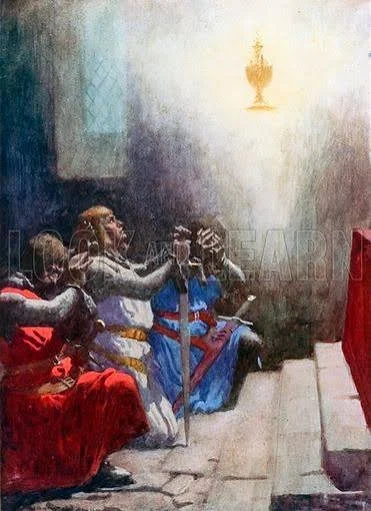
Revisiting Sir Thomas Malory’s book of the Sankgreal.
The quest for the grail has become a metaphor. ‘A cure for Cancer is the holy grail of medical research’ or ‘The world cup is the holy grail of English football.’ As metaphor, the phrase suggests something that is both hard to find and the ultimate goal of an endeavour. The search for it requires hard work, skill, courage and perseverance.
In Malory’s version of the Grail Quest, while the grail itself is both difficult to find and desirable, hard work, skill, perseverance and courage are almost irrelevant. His version is strange and disturbing. It is not an allegory of rightful Christian behaviour for the reader to decode. Instead, the world of the story is charged with meaning, and it is the knights who have to interpret it.
There are numerous dreams, castles that disappear, magical ships, and encounters with strangers whose virtue and trustworthiness are always doubtful. Time is bent. Fortunately for the reader and the knights there are hermits and anchorites, and centuries old characters on hand to provide explanations.
The morality of the quest is difficult to untangle, the theology, if there is any, is either reducible to ‘be a virgin and don’t sin’ or impossible to decode. By the end of the Quest the story has turned on itself. It begins in sadness and ends with a sense of defeat and pointlessness.
There is nothing triumphant or glorious about the first section. After Galahad has been introduced, and the grail is seen, Gawain, the least spiritual of the more famous knights, swears an oath that he will find the grail. If you think of the modern metaphor, then Gawain’s pragmatic approach is probably what you think of.
‘…to-morne, without longer abydinge, I shall laboure in the queste of the Sankgreall, and that I shall hold me out a twelve month and a day or more if need be, and never shall I return unto the court again tylle I have sene hit more openly than hit hath bene shewed here. And iff I may not spede I shall return agayne as he that may nat be ayenst the wylle of God.’ (p 67)
Arthur is devastated. He realises that this is the end of the Fellowship of the Round Table and they will never be together ‘whole’ again. He’s right. The queen tries to talk Lancelot out of going. When the knights and their squires (but not their ladies, no ladies allowed) ride out of Camelot, the people weep. One hundred and fifty set out. Less than half will return. Only three will be successful.
Galahad, the hero of the quest, is the least likeable or interesting of Malory’s knights. He appears at the beginning of the book of the Sankgreal. His conception, told in the previous second book of Sir Tristram, is a mirror image of Arthur’s. In this case it is the woman who uses magic to transform herself into the likeness of the queen so Lancelot can be seduced and father her child.
Galahad is already perfect when he appears. Typically for Malory, there are external signs that publicly endorse and prove his perfection. He can sit in the siege perilous, which can only be done by the knight who will achieve the Grail, He can draw the sword in the floating stone, which proves he is the greatest knight in the world. He constantly meets individuals who tell him he will achieve the grail. There is never any doubt that he will.
He rides through the story, unscathed and untempted. The world has been waiting for him. As predicted, he achieves the grail. Then he exits the story and the world. His soul carried up to heaven by bands of visible angels. His one wish is to escape his body. It’s not even clear why he is so wonderful, except that he is ‘without sin’, a virgin and via Lancelot related to Christ. His is a sanctioned form of extreme selfishness.
The other two successful knights are tested.
Perceval is almost seduced by a demon and saves himself at the last moment though more by luck than judgement. Being chaste is the most important factor in the search for the Grail.
Bors, who is the third successful Knight and the one that gets forgotten, has adventures that suggest, convincingly, that no moral code could help him. Even the test of his chastity is complicated when the women who is trying to seduce him declares that if he won’t be her lover she will kill herself and all her ladies.
He is tested in ways that show the world is far more complicated and morally ambiguous than the simplicity of a Galahad suggests.
When Bors sees his brother, Sir Lionel, captive, stripped and beaten as he is about to rescue him a woman calls on him to protect her from rape.
The choice is impossible, but Bors saves the woman. When he meets him later, Lionel will not forgive him. Lionel arms himself with the express purpose of killing Bors. Bors asks for forgiveness, but Lionel is adamant. When Bors kneels in front of his mounted brother, refusing to fight, Lionel tramples him unconscious. A holy man comes out and remonstrates, trying to stop Lionel from ripping off his brother’s helmet to kill him. Lionel beheads the holy man. Another knight appears and tries to save Bors, but Lionel kills him as well. Finally, Bors confronts his choice. He can die or kill his brother. God saves him from his dilemma. But isn’t solved.
For the other knights, while everything might mean something else, it’s not at all clear what criteria any of them could use to distinguish between one supernatural messenger or the other. A castle that is real, with people who need help, or a castle that will crumble when the test is passed. While the story wants to believe that being faithful and sinless is enough, the world it describes is far too complicated for such simplicity.
Perceval’s sister, who appears to be so wise in the symbolism and history of the grail, willingly allows herself to be bled to death so someone else can be temporarily healed. There is no exegesis offered for her actions, or explanation of why being the willing victim of such a vicious custom is admirable. The castle where this happens and all its inhabitants are destroyed ‘by the vengeaunce of Oure Lorde.’
And perhaps this leads to the idea that the Grail Quest is ambivalent from the start. The Knight that finds the grail, the most perfect of the Round Table Knights, is not fit for life in this world. The Grail quest goes both ways: it rewards the perfect human and underlines the worldly sinfulness of the knights; but the story also questions how religious perfection could function in this world.
How to tell if defending the old woman or the young woman is the morally correct choice? How to tell if the dream means what the interpreter claims it does, or if the magus is to be trusted. And instead of suggesting there’s a fixed moral law which the knights have to discover and obey, the overall impression is that everything is fraught with excess meaning that cannot discovered without a third-party interpreter who may or may not be trustworthy.
In Malory’s version of the Arthurian story, the Round Table Knights take an oath at Whitsun. The purpose of the fellowship is social, to help those who need it, to protect those who cannot protect themselves. But in the Grail Quest this social function is abandoned except for Bors saving of the woman. Galahad is selfish. His perfection has no social function. The highest of moral, theological standards, doesn’t produce a man who helps others, who shows kindness, who tries to establish justice in the world. Who has heard the lesson of the separation of the sheep and goats. It produces Galahad who wants to get off this planet and go to heaven as quickly as possible so he can bask in the joy of seeing God.
You could argue that just as the grail can be read as a criticism of the wordliness of the knights, the story itself can be read as a criticism of an ideal that offers its selfish followers no useful place in the world.
(And for those who are still searching for the Real Grail, please note it is taken up to heaven by a giant hand at the end of the Quest.)
