Yvor Winters (1900-1968)
Neither Sir Gawain, nor the Green Knight, are as well-known as Hamlet or Goliath (see previous posts). So Winter’s poem raises the question; if you don’t know the story it’s based on how effective is the poem? It becomes a stark example of the problems of literary allusion and ‘meaning’.
Winter’s poem contrasts the dangerous green, living natural world against the dead dry world of men and their self-made codes, which are like roads leading through the wilderness.
Does Gawain make the right choice?
If you don’t know the story, I’ll summarise it after the audio file.
This poem taken from ‘Yvor Winters, Selected poems, edited by Thom Gunn for the American Poets Project.
If you don’t know the story, read on.
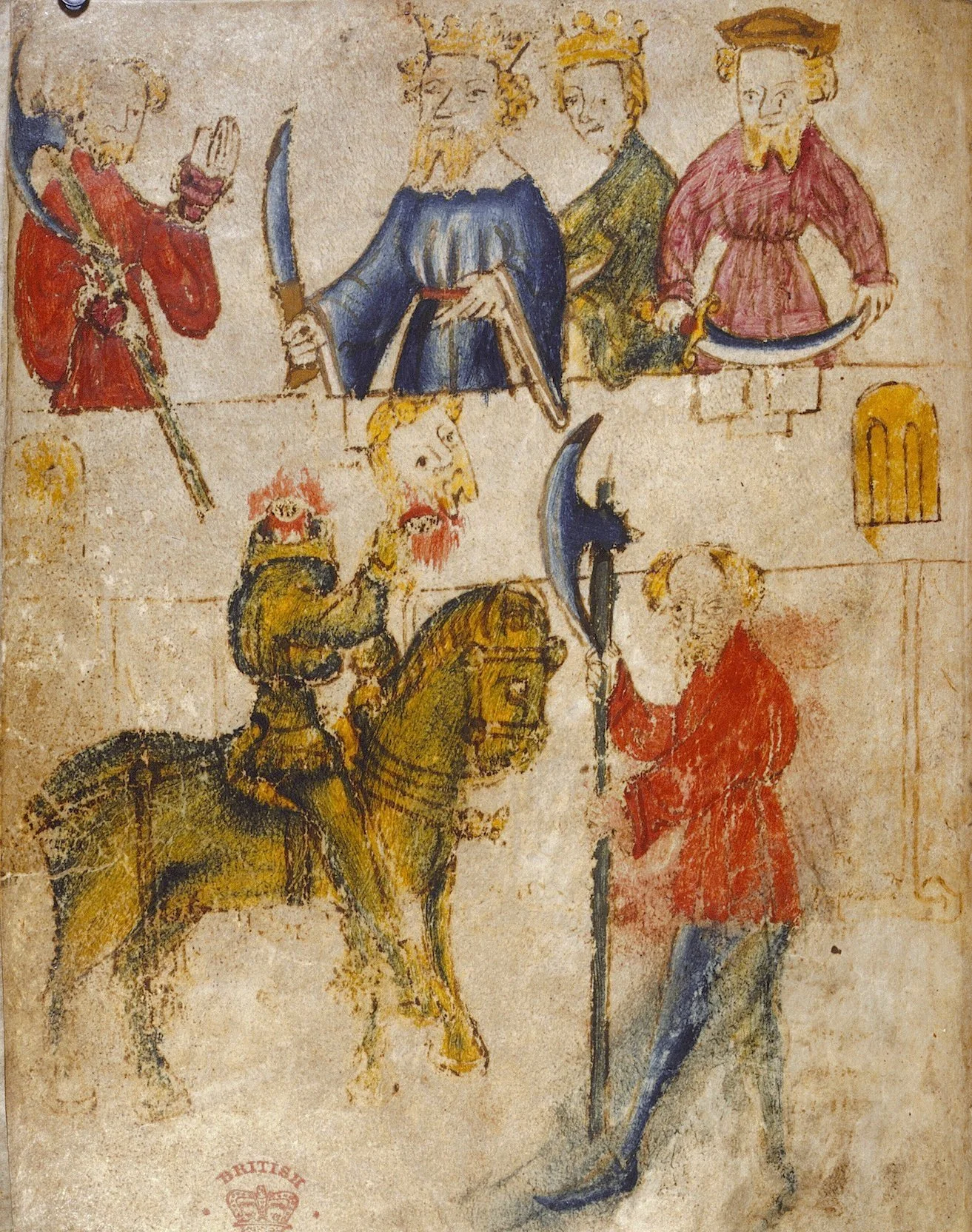
‘Sir Gawain and the Green Knight’ is a fourteenth century poem that survives in a single manuscript. The story begins in King Arthur’s court at Christmas when a huge green knight on a huge green horse rides into the court and challenges everyone to a game. He will stand one blow of his own axe as long as he can return the blow in a years’ time.
No one at the court wants to take him on, but as Arthur finally gets up the young Gawain gets in first. He effortlessly decapitates the Green Knight who then gets up, picks up his head, remounts his horse and says ‘see you in a years’ time’.
The rest of the story tells how Gawain is tested and discovers the limits of his idealism. He bravely sets out to keep his word, is undaunted by the physical hardships of a terrible journey, and finally arrives at a castle where his host tells him the place he seeks is just a few hours away, so why doesn’t he stay for three days. The host then proposes a game. He will go hunting each day and give Gawain whatever he kills, and Gawain will give him whatever he gains during the day.
For the first two days the host’s wife visits Gawain in his bedroom. His morality tested, Gawain gently rejects her advances, and she gives him a kiss. Each day the host returns, gives Gawain what he hunted, and Gawain gives him the kiss. On the third day the Lady gives him a Green Girdle which she says will protect him against the Green Knight. Gawain does not give this to the host.
He rides out to the Green Knight’s ‘chapel’. Twice the Green Knight goes to strike and twice Gawain flinches. The third time he strikes, but only nicks his neck.
When Gawain returns to Arthur’s court he is mortified. He failed the final test and tried to cheat. He wears the green girdle as a badge of his shame. But everyone in the court thinks this is daft, and starts to wear green girdles as well.
The story opens the debate. Gawain is true to his code, but as a human being he has tried to avoid death. Should he feel ashamed? Or are the people in the court right?
Quisque iaculis facilisis lacinia. Mauris euismod pellentesque tellus sit amet mollis.