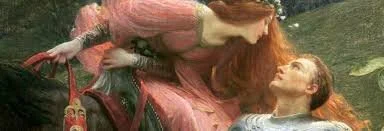
from Mathew Francis' 'The Mabinogi' Rhiannon's arrival

Mathew Francis ( Born 1956)

Rhiannon: ‘a woman wearing a shining garment  of brocaded silk on a big, fine, pale white horse’..

Rhiannon: ‘a woman wearing a shining garment of brocaded silk on a big, fine, pale white horse’..

This extract is taken from ‘The Mabinogi’, (Faber 2017), Francis’ retelling of the first four stories in the collection of eleven Medieval Welsh prose stories printed in English as The Mabinogion. The Mabinogi is the name given to the first four stories.

In this extract from the first story, Pwyll, who is prince of Dyfed, has been told that if he sits on Gorsedd Arberth, a hill overlooking his court, one of two things will happen: wounds or blows, or he will see a wonder. Because he is with an armed retinue he isn’t worried about being struck and wounded. As they sit on the hill, they see a rider approaching.

Although she seems to be ambling past, the boy sent to run after her cannot catch her. On the second day Pwyll sends a rider. No matter how fast threader drives his horse, she increases the gap between them without changing her pace.

On the third day Pwyll himself tries to catch her, and is failing miserably when he asks her to stop.

Gladly she says, and it would have been better for your horse if you’d asked a lot sooner.

Francis’ poem is not a translation, but a retelling that stays close to the original. But he captures the dreamlike quality of the original, and suggests that what we’re reading is both event and metaphor.

You can read a brief discussion the whole book here: here

(Clicking on the link will take you to a page on WWW.Liamguilar.com).

If you want to read a prose version of The Mabinogion in modern English, Sioned Davis’ version for Oxford World Classics (2008/2018) is justifiably famous.

from Mathew Francis' 'The Mabinogi'. Rhiannon's arrival
Liam Guilar

Alfred De Musset's 'On a Dead Woman' (Sur une Morte)

Alfred De Musset (1810-1857)

Alfred De Musset

Alfred De Musset

The woman in question was not dead. According to the translator, Stanley Appelbaum, ‘The ‘Morte’ of the poem, the Princess Belgiojoso, was not at all dead but coquettishly indifferent to the poet’s advances.’

This is taken from “Introduction to French Poetry’ edited by Stanley Appelbaum, who claims in his introduction that the translations are ‘definitely not intended to be poetic recreations of the original works, but merely aids to the understanding of the content’. In this case the English version seems to stand on its own..

Alfred de Musset's 'On a Dead Woman'
Liam Guilar

Rudyard Kipling's 'If'

Rudyard Kipling (1865-1936)

There was a time poems entered the language and were recycled in daily usage. And ‘If’ is perhaps one of the best examples of such a poem. It has been voted Britain’s Most popular poem, though I suspect that day has passed.

It’s full of good advice, memorably expressed. Nowhere does it suggest you need counselling or a handbook of excuses. But I can also imagine a Victorian father giving his son such a lecture, and the son walking out thinking, well, that’s that then. Not possible. Can’t do it. Might as well become some kind of debauched failure of a chronic sinner right now.

Rudyard Kipling's 'If'
Liam Guilar

Federico Garcia Lorca's 'Somnambule Ballad'

A still from Un Chien Andalou

A still from Un Chien Andalou

Frederico Garcia Lorca (1898-1936)

(Translated by Stephen Spender and J.L Gill)

For those outside Spain, who read no Spanish, Lorca is probably the most famous Spanish poet of the twentieth century.

This is a very different poem to the ones I’ve previously read on the podcast.

It helps, listening to this poem or reading it, to remember Lorca was friends with Dali and Bunuel. There is a story that when those two were making Un Chien Andalou, their ground breaking ‘surrealist’ film, one would sketch scenes and the other would say, no, that means something, throw it out.

‘Avant Garde’ and ‘Surrealist’ are terms that might be useful as pathways to approach this poem without necessarily being definitive or even accurate as labels.

For a long time I used this poem as an example of what happens when readers are confronted with work they find initially incomprehensible. Read it, I’d say, then come back and tell me what you think it means. The answers were often ingenious. They varied greatly. They were all interesting.

So what does it mean they’d ask.

It means what it says. Images that link without narrative, suggesting narrative, cohering because they linked in the writer’s mind at the time of writing. The links are not made explicit. But the images sing together.

Yes, but what does it mean?

Wrong question.

This is taken from ‘The Selected poems of Federico Garcia Lorca’ edited by Francisco Garcia Lorca and Donald m. Allen. A New Directions paperback 1985.


Federico Garcia Lorca's 'Somnambule Ballad'
Liam Guilar

Ovid's 'Pygmalion' trans Arthur Golding

pygmalion.jpg

Arthur Golding (1536-1605)

Publius Ovidius Naso (43 Bc-17/18 AD)

Ovid’s ‘Metamorphosis’ written in Latin in the first decade of the First Century AD, long before England was invented, is ironically one of the key texts in English poetry and Ovid one of its most influential poets. One of the reasons for the popularity of the Metamorphosis after the Middle Ages is Golding’s translation, which influenced so many who read it, including one W. Shakespeare.

The story of Pygmalion lives on in Shaw’s play and the musical version of Shaw’s play, and nothing makes it any less disturbing. It also lives on in ‘The Pygmalion effect’, the idea that high expectations in management or teaching can lead to enhanced results because of the ‘self fulfilling prophecy’.

Whatever the leadership gurus make of it, like most of Ovid’s stories, it’s disturbing. But then you’ve probably met at least one deluded person who recreated a human being as an unrealistic ideal and you might have been unlucky enough to be around to see the damage that caused.

Ovid's 'Pygmalion' trans Arthur Golding
Liam Guilar

Sappho's 'Fragment 31'

Sappho (c600 BC)

jbs.jpg

Possibly the most famous female poet in history? Well known and highly respected in her own Greek culture. Her name is still very well known, though perhaps for the wrong reasons. Very little of her work survives, and most of it seems to be fragments.

There are numerous attempts at translating this particular poem: Catullus, Campion, Bunting and others have done their best. I like this version because it respects the fragment and works as a poem.

This is taken from Sappho, Poems and Fragments, translated by Josephine Balmer. Published by Bloodaxe books.

Sappho's 'Fragment 31'
Liam Guilar

Charles Hamilton Sorley's 'When you see millions of the mouthless dead'

Charles Hamilton Sorley ( May 1895- October 1915)

chs.jpg

Sorely was killed by a sniper in 1915 while serving on the Western Front. This poem, written in pencil, was found amongst his belongings.

The few poems he had written were collected and published in January 1916 as ‘Marlborough and other poems’. This is taken from the slightly enlarged second edition of February 1916.

Had Sorely lived and continued to write, most of the poems in the book would probably have been filed away as ‘Juvenilia’. As it was, he didn’t get to revise any of them for publication.

He has been particularly well-served by Jean Moorcraft Wilson who not only wrote a Biography but collected and edited his letters and his poems.

You can read more about Sorely here:

https://ladygodivaandme.blogspot.com/2017/05/charles-hamilton-sorely-footnote-poet.html

Charles Sorley's 'When you see millions of the faceless dead'
Liam Guilar

Carol Ann Duffy's 'You'

Carol Ann Duffy (1955-)

This is the first poem in Duffy’s ‘Rapture’ (2005), which is either a book length love poem or a book length sequence of poems which chart the rise and fall of a passionate love affair. ‘Rapture’ won the T.S.Eliot Prize in 2005.

For many people the relationship between love and poetry seems a simple one. But of the thousands of poems written each day, and the thousands published each year, there are very few good love poems. As an experiment, pick up a general anthology of English poetry through the ages and see how many you can find. As is often pointed out: ‘I love you’ may be the most beautiful thing you’ll ever say, or hear, but it’s not a poem.

Because of this, ‘Rapture’ is an outstanding collection, as the poems move from ‘Love’s first plague to her wintry fever’.

Carol Ann Duffy's 'You'
Liam Guilar

John Keats' 'La Belle Dame Sans Merci'

John Keats (1795-1821)

la belle dame.jpg

John Keats

In Tennyson’s Lady of Shalotte, the metaphor is buried by the story. In La Belle Dame sans Merci, the story is the metaphor. The narrative is as straightforward as a fairy tale, though it also reads like a nightmare.

 There are several suggestions as to what the story ‘means’: La Belle Dame is tuberculosis, Infatuation, Fanny Brawne, male fear of the feminine. You can take your pick.

What Keats thought it meant is a different matter.  The poem first appeared in a long letter he wrote to George and Georgina Keats.

At the end of the poem he wrote:

Why four kisses-you will say-why four because I wish to restrain the headlong impetuosity of my Muse-she would have fain said ‘score’ without hurting the rhyme-but we must temper the Imagination as the Critics say with Judgement. I was obliged to choose an even number that both eyes have fair play: and to speak truly I think two a piece quite sufficient-suppose I had said seven: there would have been three and a half a piece-a very awkward affair, and well got out of on my side- 

Which doesn’t sound like he was taking it or himself too seriously.

The poem is also a candidate for the prize for worst editing of a poem by the person who wrote it. When Keats published the poem in The Indicator, he changed the first line to: 

Ah what can ail thee wretched wight…

Which is awful.  His defenders claim that by this time his illness was so advanced his judgement was impaired.

The poem, even more than the Lady of Shalotte, appealed to painters in the 19th century.


John Keats' 'La Belle Dame Sans Merci. A Ballad'
Liam Guilar

Thomas E. Spencer's 'How McDougall topped the score'

Thomas E. Spencer (1845-1911)

I know nothing about Spenser except he wrote this poem and I own a signed, 1906 copy of ‘How McDougall Topped the Score and other sketches and verses’. I don’t even know why I have the book.

According to Wikipedia Spencer migrated to Sydney, Australia in 1875 and became a successful builder and contractor, winning government contracts for work on Goulburn gaol, the University of Sydney's physics laboratory and the sewerage system in Sydney.

‘How McDougall Topped the Score’ is a fine example of a recognisable type of Australian poem from the first half of the last century. An entertaining story, not meant to be taken seriously, but enjoyed for the pleasure of the thing itself. It’s also very enjoyable to read aloud.

T.E.Spencer's 'How McDougal topped the score'
Liam Guilar